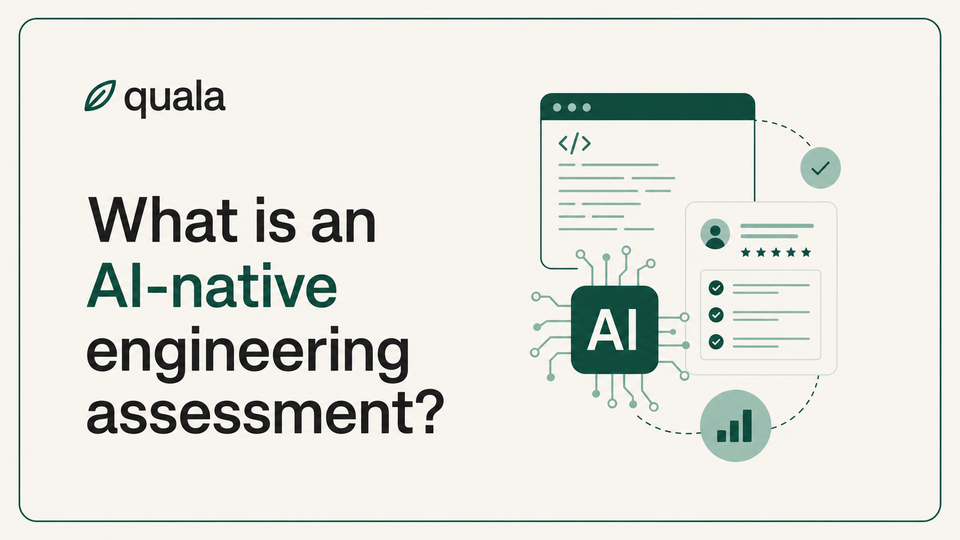
What is an AI-native engineering assessment?
Software engineering has changed more in the past three years than in the previous decade.
AI coding tools like Cursor, Claude Code, GitHub Copilot, and other AI assistants are now part of many developers' daily workflow. Engineers use them to explore solutions, generate boilerplate, debug issues, write tests, and accelerate delivery.
Yet most technical hiring still evaluates candidates as if AI doesn't exist.
Traditional coding assessments were designed for a world where developers worked alone, wrote every line of code manually, and were expected to solve isolated programming problems without external assistance. Modern engineering looks very different.
That's why a new category of technical evaluation is emerging AI-native engineering assessments.
Rather than asking whether someone can solve an algorithm problem without AI, AI-native assessments measure how engineers solve real engineering problems in the way they actually work today – with AI as part of their workflow.
AI-native engineering assessment vs traditional coding assessment
Traditional coding assessments were built to answer a simple question:
“Can this candidate write code?”
For years, that was a reasonable proxy for engineering ability.
Today, it isn't enough.
Modern software development involves much more than writing code. Engineers define requirements, break down complex problems, collaborate with AI tools, validate generated solutions, debug unexpected behavior, review tradeoffs, and make architectural decisions.
A candidate may complete an algorithm challenge flawlessly and still struggle in a real engineering environment. Likewise, an engineer who works exceptionally well with AI may perform poorly in a traditional coding interview because the assessment measures skills that are becoming less representative of day-to-day work.
This doesn't mean coding ability no longer matters. It means coding is now only one part of engineering.
An AI-native engineering assessment reflects that reality. Instead of measuring isolated programming performance, it evaluates the broader engineering workflow—including how candidates reason, iterate, validate, and collaborate with AI to solve practical problems.
*The complete engineering process includes: how the candidate decomposes complex tasks into subtasks, formulates prompts for AI models, and validates the generated results in practice
The difference isn't simply allowing AI tools. It's recognizing that engineering performance depends on much more than the code a candidate produces.
What does an AI-native engineering assessment measure?
An AI-native assessment evaluates the capabilities that determine success in modern software engineering—not just whether someone can produce a working solution.
AI collaboration
AI has become part of the development environment. Strong engineers know how to use it intentionally.
They provide context, guide AI toward better solutions, question incorrect suggestions, iterate on generated code, and know when to rely on their own judgment.
Using AI effectively is becoming an engineering skill in its own right.
Engineering judgment
AI can generate code in seconds.
Determining whether that code is correct, secure, maintainable, and appropriate for a production system still requires human expertise.
Engineering judgment includes making tradeoffs, recognizing technical risks, selecting appropriate architectures, and improving AI-generated solutions rather than accepting them at face value.
Problem solving and debugging
Real engineering rarely begins with a perfectly defined problem.
Requirements evolve. Systems behave unexpectedly. Dependencies fail. Initial solutions need refinement.
Strong engineers investigate, test assumptions, debug systematically, and adapt their approach as new information emerges.
These skills are difficult to measure through isolated coding puzzles but central to everyday engineering work.
Code quality
Shipping code is only part of the job.
Engineers are responsible for writing software that other people can understand, extend, and maintain.
An effective assessment looks beyond whether code works. It also considers readability, testing strategy, maintainability, and the decisions behind the implementation.
Are AI-native assessments replacing coding interviews?
Not entirely.
Technical interviews remain valuable for evaluating communication, collaboration, architectural thinking, and team fit.
AI-native assessments make those conversations more meaningful.
Instead of spending interview time solving algorithm puzzles, hiring teams can discuss design decisions, tradeoffs, debugging strategies, and engineering judgment—because candidates have already demonstrated how they work in a realistic engineering environment.
The assessment becomes a foundation for better interviews, not a replacement for them.
What should companies look for in an AI-native assessment platform?
As more assessment platforms begin incorporating AI, it's important to distinguish between adding AI features and being genuinely AI-native.
A modern assessment platform should:
- simulate realistic engineering work rather than isolated coding exercises;
- allow candidates to use AI tools naturally;
- evaluate the development process, not just the final solution;
- measure engineering judgment alongside technical execution;
- capture debugging, iteration, and decision-making;
- provide hiring teams with actionable insights instead of a single score.
The objective isn't simply to identify who completed a task.
It's to understand how each candidate approaches engineering problems.
The future of engineering hiring Is AI-native
Software engineering has entered a new era.
AI is changing how engineers write, review, and maintain software. As workflows evolve, hiring practices need to evolve as well.
The future of technical hiring isn't about preventing candidates from using AI. It's about understanding how effectively they use it.
AI-native engineering assessments reflect this shift.
They evaluate the capabilities that increasingly define successful engineers: technical judgment, problem solving, AI collaboration, debugging, and the ability to make sound decisions in complex, real-world scenarios.
The question is no longer:
"Can this engineer write code without AI?"
A better question is:
"Can this engineer build great software with AI?"
Companies that learn to answer that question will have a significant advantage in identifying the next generation of engineering talent.
Member discussion